
Leadership Is Not Heroic. It’s Horticultural.
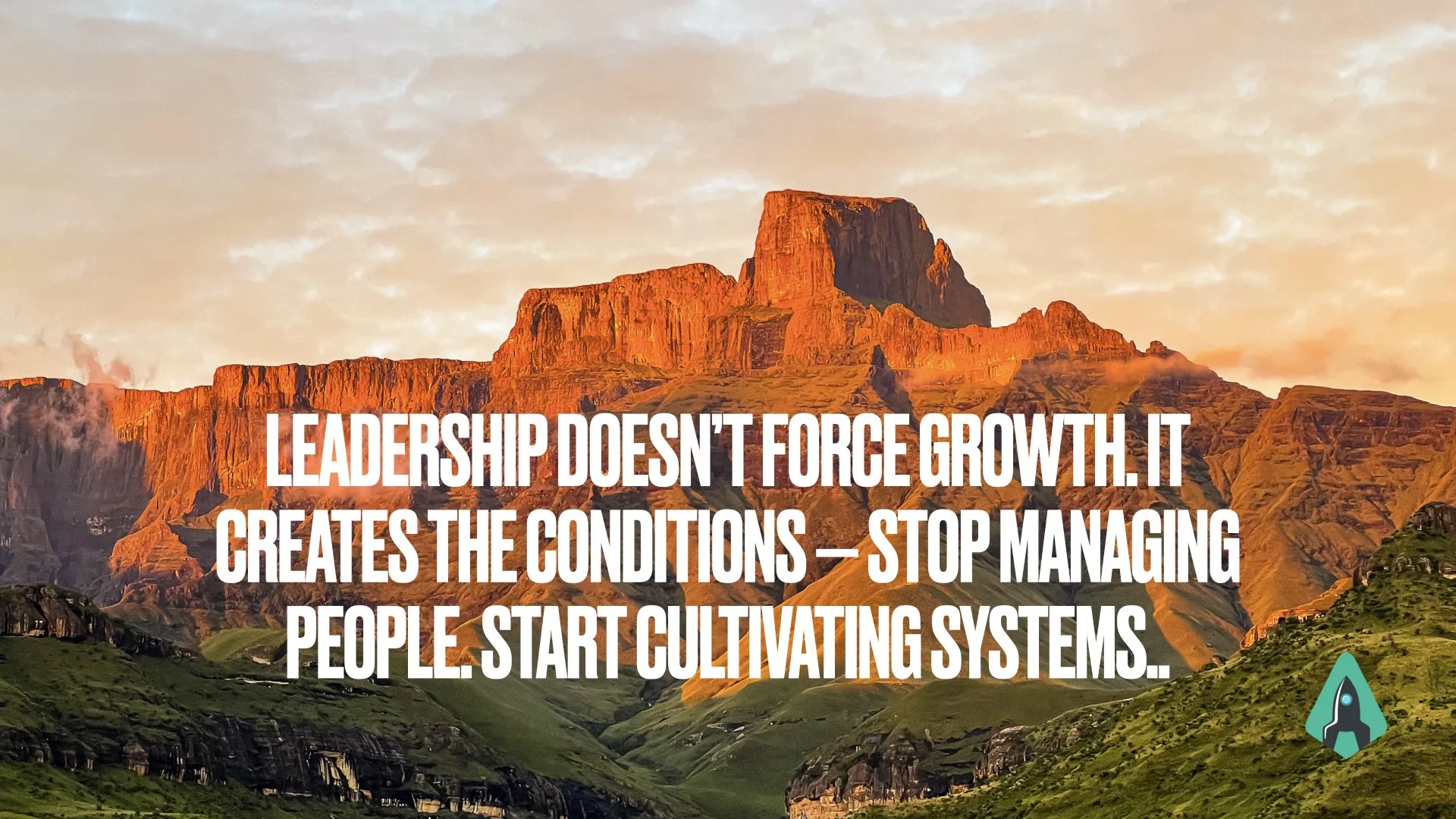
For a long time, leadership has been framed as something heroic.
Decisive. Visible. Certain. In control.
We celebrate leaders who move fast, speak loudly, and seem to have answers for everything. We reward confidence, clarity, and execution power. Especially in times of uncertainty, the call for “strong leadership” becomes louder.
But what if this image is part of the problem?
In a world that is volatile, uncertain, complex, and ambiguous, leadership based on control and heroics reaches its limits surprisingly fast. Not because leaders lack effort — but because living systems do not respond well to force.
A different image of leadership offers a more useful orientation:
the garden — and the gardener.
The Garden as a Leadership Model
A garden is not chaos.
But it is also not a machine.
It is a living system.
There is structure, intention, and care — yet no full control. Growth depends on conditions, timing, diversity, and forces beyond direct influence. Weather changes. Plants behave differently each year. Unexpected things emerge.
A gardener knows this.
They plan, but they don’t dominate.
They influence, but they don’t command.
They accept that their role is limited — and still essential.
Leadership today looks very similar.
Organizations are living systems too. People interact, adapt, resist, cooperate, withdraw, grow, and sometimes wither. The more complex the environment, the less effective purely mechanistic leadership becomes.
This is where the gardener mindset matters.
From Control to Conditions
A gardener does not grow plants by pulling on them.
No amount of force will accelerate growth.
Instead, they focus on conditions:
the quality of the soil
access to light and water
protection from harmful influences
space to grow
boundaries that prevent domination
Growth happens — or it doesn’t. But it cannot be forced.
Leadership works the same way.
When leaders try to compensate for weak systems with pressure, micromanagement, or permanent urgency, they often exhaust the very people they rely on. Performance may increase briefly, but resilience disappears.
Gardener-leaders ask a different first question:
What conditions are we creating — every day?
Not:
Who is underperforming?
Who needs more pressure?
Who should be pushed harder?
But:
What enables people to do good work here?
What gets in their way?
What is draining energy unnecessarily?
Growth and Rest Belong Together
Every garden follows rhythms.
There are phases of growth, flowering, harvest — and phases of rest. Soil needs recovery. Plants need time to regenerate. Without rest, fertility declines.
Many organizations pretend these rhythms do not exist.
Permanent high performance.
Permanent availability.
Permanent acceleration.
In nature, this leads to collapse.
In organizations, it leads to burnout, disengagement, and quiet resignation.
Gardener-leaders think in cycles, not only in targets. They understand that rest is not the opposite of performance — it is a precondition for it.
This requires courage, because it often contradicts short-term optimization logic. But sustainable leadership is not about extracting maximum output today. It is about keeping the system alive and capable of renewal tomorrow.
Diversity Is Not a Risk — It’s Resilience
No healthy garden is a monoculture.
Different plants grow at different speeds. Some need sun, others shade. Some are robust, others fragile. Together, they create stability.
A gardener respects this diversity. Treating all plants the same would be negligence, not fairness.
Leadership often struggles here.
Organizations standardize what should be differentiated:
identical expectations
uniform career paths
narrow definitions of success
This simplifies management — and weakens the system.
Gardener-leaders pay attention. They notice who needs space, who needs protection, who thrives under challenge, and who contributes quietly. They design environments where different strengths can coexist.
Uniformity is efficient.
Diversity is resilient.
Letting Go Is Part of Care
Not everything that grows should stay.
Some plants exhaust the soil.
Some block the light.
Some no longer fit the space.
A good gardener notices and acts — calmly, without drama.
Leadership includes letting go as well:
of structures that once worked
of roles that no longer serve
of people who have outgrown the system — or whom the system no longer supports
Holding on out of nostalgia or fear weakens the whole garden.
Letting go is not failure.
It is maintenance.
Leadership Is Presence, Not Performance
A gardener is not a heroic figure.
They don’t shine.
They don’t dominate the scene.
They rarely get credit for what grows.
They observe, adjust, protect, and intervene when necessary. Much of their work is invisible. And yet, without them, the garden declines.
Leadership today needs less spectacle — and more presence.
Less ego.
More attention.
Less control.
More care.
Not because leadership should be soft — but because living systems require a different kind of strength.
A Different Question
The gardener mindset ultimately changes the core leadership question.
Not:
How do I get more out of people?
But:
How do I create conditions in which people — and the organization — can grow without being exhausted?
The future of leadership may not be heroic at all.
It may be quieter.
More patient.
More humble.
And far more effective.